Norman · the Ozarks
Launch price $27 $47 Get the Handbook →
Norman ——— Grown, not foraged

Stop waiting on the woods. Grow the mushrooms yourself — out of a bucket.

Thirty-one methods I've run in the shed behind my house — from a $0 cardboard roll to logs that feed you for years. No lab. No expensive gear. No foraging luck required.

Launch price ends in 00:00:00
31
Tested methods
4
Tiers, cheap to patient
142
Pages, fully illustrated

Norman, at home in the Missouri Ozarks
“For everyone who was told they needed a laboratory, and went looking for a bucket instead.” — Norman

I
The Handbook

This is a working handbook, not a book about mushrooms.

For twenty-two years I did what a lot of folks reading this do. I foraged. I walked the same six ridges every April looking for morels, and I was good at it, and it was never enough. Some years the rain came wrong and there was nothing at all. Some years somebody got to my spot first.

Then a neighbor showed me a five-gallon bucket packed with wet straw, gray oysters coming out of the sides of it like shelves off a stump. He hadn't gone anywhere. He hadn't waited on weather. The mushrooms had come to him — on a Tuesday, in his garage.

There's very little in here about the wonder of fungi and a great deal about what to put in a bucket on Saturday morning. Thirty-one methods, and I've run every one of them in a shed behind my house — several of them dozens of times, a few of them badly, so you don't have to.

Underneath all of it sit four Ground Rules that every method is really doing. Once you have them, the thirty-one ways stop being thirty-one things to memorize and become one thing done thirty-one ways. If a method ever fails you, that's where the answer is.

They're ordered cheapest to most patient. Start at a dollar. End with a log bed that feeds you for years.

II
The Difference

You had no say in when the woods would give you another one.

Foraging means asking. Growing means the harvest shows up on your schedule, in your garage, whether the season cooperates or not.

Waiting on the woods

The old way

  • Walk the same six ridges and hope the timing's right
  • Some years the rain comes wrong — nothing at all
  • Somebody gets to your spot first
  • Come home with a bag that has to last
  • Told you need a lab, a pressure cooker, expensive gear
The mushrooms come to you

Growing at home

  • A bucket packed on a Saturday morning
  • Indoor methods run year-round, no notice of the calendar
  • Nobody to beat to it — it's in your garage
  • Mushrooms in the house all year, and second flushes free
  • Cardboard, coffee grounds, jars, and straw — that's the gear
III
What's Inside

Thirty-one ways, in four tiers — cheapest first, most patient last.

Numbered straight through. Eighteen are full builds; thirteen are honest one-page variations that name the method they descend from and get out of the way.

Tier One — Cardboard & Coffee

Ways 1–7
Nothing costs more than a few dollars. Three cost nothing at all.
  1. The Cardboard Roll
  2. The Coffee Ground Bucket
  3. The Toilet Roll Grow · var. of 1
  4. Bucket Tek: Straw in Five Gallons
  5. The Laundry Basket · var. of 4
  6. The Coffee-and-Cardboard Brick · var. of 2
  7. The Grocery Bag Grow · var. of 4

Tier Two — The Jar Tier

Ways 8–15
Stop buying spawn and start making it. The part that pays for the book.
  1. The Spore Print & Syringe
  2. Mason Jar Liquid Culture
  3. The Pill-Bottle Agar Plate
  4. Cloning a Mushroom You Already Own
  5. The Cardboard Spawn Multiplier
  6. Sawdust Spawn Without a Pressure Cooker
  7. Lime-Bath Grain Spawn
  8. The Jar-to-Bag Transfer · var. of 14

Tier Three — Humidity Containers

Ways 16–22
Bags, tubs, tents, and towers. Where yields get serious.
  1. The Bread-Bag Grow Bag
  2. The Storage-Tote Monotub
  3. The Shotgun Fruiting Chamber
  4. The Shelf-Rack Humidity Tent · var. of 18
  5. The Martha Tent from a Greenhouse Shelf · var. of 19
  6. The Bucket Tower · var. of 4
  7. The Windowsill Jar · var. of 16

Tier Four — Logs, Chips & Beds

Ways 23–31
Goes outside. Takes the longest to start — then feeds you for years.
  1. The Wine Cap Mulch Bed
  2. Shiitake on Logs
  3. The Totem Stack
  4. Stump Inoculation · var. of 25
  5. The Wood Chip Path · var. of 23
  6. The Straw Bale Grow · var. of 4
  7. The Buried Bucket Bed · var. of 23
  8. Forced Fruiting: The Log Soak
  9. The Spent-Block Bed

The Ground Rules

The four things every method is really doing. Learn these and failure has an address.

When It Goes Wrong

The chapter you'll actually use most — green mold, no pins, contamination, and how to tell a stall from a loss.

Two More Things

Bringing a wild mushroom home the safe way, and cooking what you grew.

Every full method is laid out the same way

Read one and you can find anything in any of the others without hunting.
A scene — what it actually is What It Costs — to the dollar The Build — in the order your hands do it When To Pick The Second Flush — the free harvest The Honest Word — how it fails The Math — in vs. out
Get all 31 methods · $27$47
Instant download · Yours forever
IV
Reader Results

Something white and alive where there was only wet cardboard.

★★★★★

“Started with Way 2 — a coffee-ground bucket by the back door — because it cost me nothing. Three weeks later my wife thought I'd bought oysters at the store. I hadn't left the house.”

Dale R. · started with Tier One
★★★★★

“I'd foraged for years and always felt cheated by dry springs. The jar tier changed that. I make my own spawn now and I haven't bought a thing in months.”

Marie T. · retired, zone 6
★★★★★

“Put in a wine cap bed along the garden path last fall the way Norman lays it out. It came back on its own after the first soaking week. Feels like cheating.”

W. Hollis · Tier Four, outdoors
V
About Norman
Norman

Twenty-two years a forager. Now the growing is what feeds us.

I live in a hollow in the Missouri Ozarks. I still walk the ridges in April — but I stopped depending on them the day a neighbor showed me a bucket of oysters he'd grown in his garage. I've been growing ever since, alongside the foraging, and the growing is the part that actually puts mushrooms on the table.

Everything in this handbook I've run myself, in a shed behind the house. If a method here doesn't work the way I said it would, I want to hear about it — write to me through the channel, and I'll fix it in the next edition and say who caught it.

Norman
The Ozarks · 2026
VI
Get the Handbook

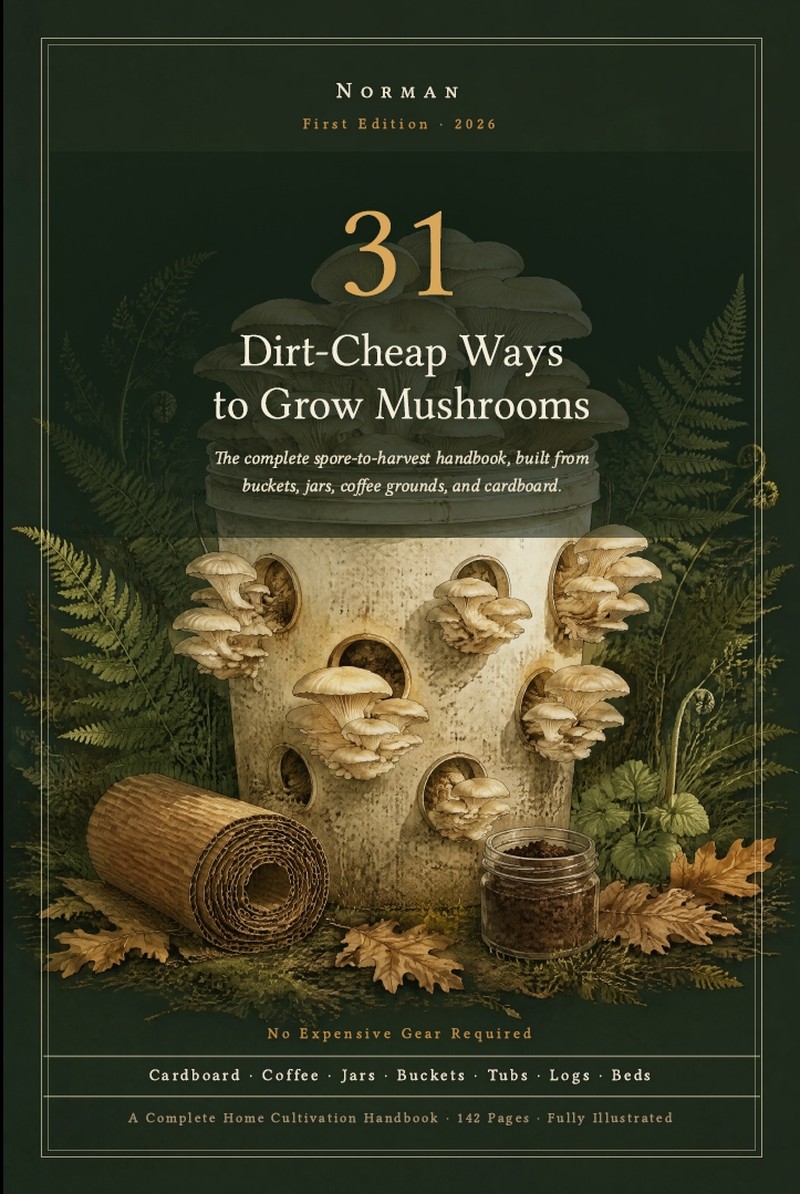
31 Dirt-Cheap Ways to Grow Mushrooms

The complete spore-to-harvest handbook. Instant PDF download — read it on any phone, tablet, or computer, or print your own copy.

The Complete Handbook — First Edition
142 pages · fully illustrated · instant download
  • All 31 tested methods, across four tiers — cardboard to log beds
  • The four Ground Rules that make every method one thing done 31 ways
  • When It Goes Wrong — the full troubleshooting chapter
  • Two More Things — bringing wild mushrooms home safely & cooking your harvest
  • A Year in the Yard — a planting calendar for the outdoor methods
  • The grow log at the back to track every batch
$47$27
Launch price — save $20 while the timer runs
Get Instant Access →
Instant download · Yours forever
VISAMASTERCARDAMEXPAYPAL · secure checkout via Gumroad
VII
Questions

Straight answers before you buy.

Is this a foraging or wild-mushroom ID guide?
No — and it's important you know that. This is a cultivation handbook: growing mushrooms from known, purchased, or self-propagated cultures. It is not a field guide and must never be used as one. No book or photograph can identify a wild mushroom — only a qualified person with the specimen in hand can. Several North American species are lethal in small amounts. If you ever suspect someone has eaten a mushroom of uncertain identity, call Poison Control (1-800-222-1222 in the US) immediately.
Your videos are free — why buy the book?
The channel gives you a method here and a method there. The handbook is all thirty-one in order, cheapest to most patient, with the four Ground Rules underneath them so a failed batch has an address — plus the full When It Goes Wrong chapter and a grow log you'll actually use. It's the difference between watching me do it and having the whole system on the shelf when your jar stalls at 9pm.
Why is it only $27?
Because the whole book is about not spending money you don't have to. It would be a strange thing to charge like a textbook for a method that starts with a coffee-ground bucket. $27 is the launch price ($47 after); it covers the years of running these in the shed, and not much more.
Do I need special equipment or a lab?
No. That's the point of the book. Tier One needs cardboard, coffee grounds, straw, and a bucket. Even the jar tier — where you make your own spawn — is written to work without a pressure cooker. If a method needs something, the "What It Costs" line tells you to the dollar, with what you can substitute.
What format is it, and what do I get?
A single illustrated PDF — 142 pages, First Edition 2026. It opens on any phone, tablet, or computer, and you're granted the right to print one personal copy. Delivery is instant through Gumroad the moment you check out. Yours to keep.
I've never grown anything. Is this for beginners?
Yes — it's ordered for exactly that. Start at Way 1 with a cardboard roll, finish it, write down what happened, then start another. The people who struggle aren't the ones short on gear; they're the ones who start six things in one weekend and can't tell which variable killed which jar. One at a time.